












Kudos has partnered with CardRatings and Red Ventures for our coverage of credit card products. Kudos, CardRatings, and Red Ventures may receive a commission from card issuers. Kudos may receive commission from card issuers. Some of the card offers that appear on Kudos are from advertisers and may impact how and where card products appear on the site. Kudos tries to include as many card companies and offers as we are aware of, including offers from issuers that don't pay us, but we may not cover all card companies or all available card offers. You don't have to use our links, but we're grateful when you do!

Can You Pay Western Union With a Credit Card? (2026 Guide)
July 1, 2025



Quick Answer: Which Cards Does Western Union Accept?
Western Union accepts credit and debit cards issued on most major payment networks — but not all:
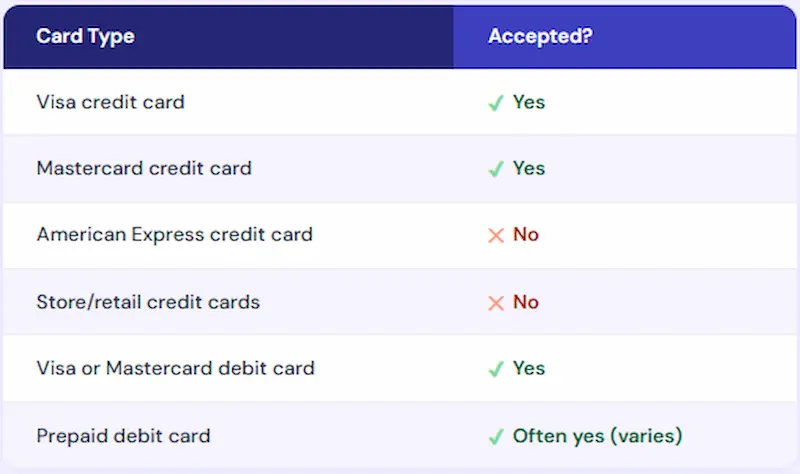
American Express cards are not accepted by Western Union for direct money transfers — online, in-app, or in person. If you hold only an Amex card, your options are to use a debit card, bank account, or cash at an agent location.

Is Using a Credit Card for Western Union a Cash Advance?

Yes — in almost every case. When you use a credit card to fund a Western Union money transfer, your card issuer treats it as a cash advance, not a regular purchase. This is because credit card networks flag wire transfers and money transfers as "cash-equivalent" transactions — similar to withdrawing cash from an ATM, buying a money order, or purchasing casino chips.
The practical consequence is significant: you are not buying goods or services, so your issuer applies its cash advance terms, which are considerably less favorable than purchase terms.
This has been confirmed in real-world testing across multiple cards. Cards from major issuers including Chase and Citi have all coded Western Union transfers as cash advances — meaning no rewards earned and immediate interest accrual.

The Real Cost: What You'll Actually Pay
Using a credit card with Western Union typically triggers fees from two separate sources. Here's a breakdown:
Western Union's Transfer Fee
Western Union charges a service fee on every transfer. Credit card-funded transfers carry higher fees than transfers funded by bank account or debit card. The exact fee depends on the transfer amount, destination country, and delivery method. You can estimate costs in advance using Western Union's price estimator on their website or app.
Your Card Issuer's Cash Advance Fee
On top of WU's fee, your credit card issuer charges a separate cash advance fee. This is typically:
- 3%–5% of the transaction amount, or
- A flat fee (often around $10), whichever is greater
So if you send $500 via Western Union with a credit card and your issuer charges a 5% cash advance fee, that's an additional $25 — before a single dollar reaches the recipient.
Cash Advance APR — Immediate, No Grace Period
Cash advance interest rates are typically significantly higher than your card's regular purchase APR. More critically, there is no grace period. Unlike regular purchases where you can pay your balance in full by the due date and owe zero interest, cash advances begin accruing interest from the moment the transaction is processed — every single day until you pay it off.
No Rewards Earned
This is one of the most commonly misunderstood points: credit card cash advances do not earn rewards. No points, no miles, no cash back — regardless of your card's normal earning rates. If you were hoping to earn rewards on a large Western Union transfer, that won't happen when the transaction codes as a cash advance, as it almost always does.
Combined Cost Example
Here's what a $500 Western Union transfer via credit card could realistically cost:
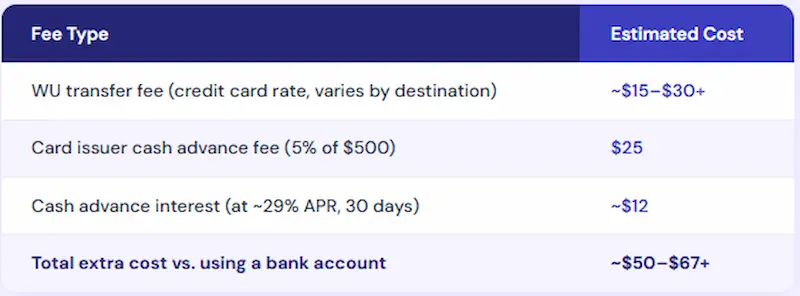
Actual fees vary by card issuer, destination, and transfer amount. Always check your cardholder agreement before proceeding.
How to Check Your Card's Cash Advance Terms
Before using a credit card for a Western Union transfer, take two minutes to check your card's specific cash advance terms:
- Review your cardholder agreement — look for the "Cash Advance" section in the Rates & Fees table. This will show your cash advance APR and fee structure.
- Call the number on the back of your card — ask your issuer specifically: "If I use this card to fund a Western Union money transfer, will it be treated as a cash advance?"
- Check your online account or app — many issuers now show your cash advance limit and APR in the account summary.
Knowing your terms in advance avoids unpleasant surprises on your next statement.
Step-by-Step: How to Pay Western Union With a Credit Card
If you've weighed the costs and still want to proceed, here's how to complete the transfer:
Step 1 — Choose your transfer method: You can initiate a Western Union transfer online at westernunion.com, through the Western Union mobile app, by calling Western Union directly, or by visiting a physical agent location.
Step 2 — Create or log in to your Western Union account: New users will need to register with a name, email, and password. Existing users sign in as normal. Western Union uses TLS encryption to protect your card details and personal information.
Step 3 — Enter recipient details: Provide your recipient's full name, country, and preferred delivery method: cash pickup at a WU location, bank deposit, or mobile wallet top-up.
Step 4 — Enter the transfer amount and review fees: Use Western Union's price estimator to see the full transfer cost before committing. Note the transfer fee — it will be higher for credit card funding than for bank or debit card funding.
Step 5 — Select credit card as your payment method: Enter your Visa or Mastercard credit card number, expiration date, CVV, and billing address. Confirm the total amount including fees.
Step 6 — Note your sending limits: Western Union imposes transfer limits that vary based on your account history, profile verification level, and recipient country. Your credit card's cash advance limit may also be lower than your overall credit limit — check this before attempting a large transfer.
Step 7 — Save your MTCN: Once approved, you'll receive a Money Transfer Control Number (MTCN). Share this only with your recipient — they'll need it to pick up the funds. Keep your receipt for your records.
Delivery speed by method:
- Cash pickup at a WU agent location: usually available within minutes
- Bank account deposit: typically 1–5 business days
- Mobile wallet top-up: usually within minutes
How This Affects Your Credit Score
Beyond the fees, using a credit card for a Western Union transfer can have a few downstream effects on your credit:
Credit utilization. The cash advance draws from your credit limit, which increases your credit utilization ratio. Lenders generally prefer utilization below 30%. A large transfer can spike this ratio temporarily and may modestly lower your credit score until the balance is paid down.
No grace period means balance grows fast. Because cash advance interest starts immediately and at a higher rate, carrying the balance for even one billing cycle adds meaningful cost. This increases your total credit card debt, which also feeds into utilization.
Payment history. Your credit score is most influenced by whether you pay on time. Ensure you can comfortably pay off the cash advance balance quickly — ideally before the next statement closes.

All Payment Methods at Western Union: Compared
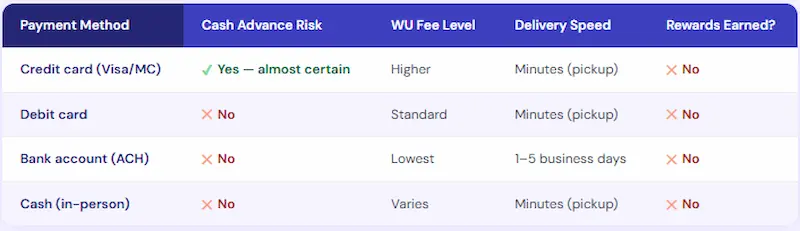
Before defaulting to a credit card, it's worth knowing what your other options look like and how they compare:
Debit Card
Debit card transactions draw directly from your bank account and are processed as regular purchases — not cash advances. You avoid the issuer cash advance fee and the elevated APR entirely. WU fees for debit card payments are also typically lower than for credit cards.
Bank Account (ACH Transfer)
Linking your checking or savings account to Western Union is the most cost-effective option. Bank transfers carry the lowest WU service fees and zero risk of a cash advance classification. The trade-off is speed: bank deposits can take up to five business days to arrive.
Cash at an Agent Location
If you have cash on hand, visiting a Western Union agent is a reliable, fee-efficient option. You can often initiate the transfer online or via the app first, then complete payment with cash at a participating location.
Should You Use a Credit Card for Western Union?
Given the layered costs involved, our honest take is: use a credit card for Western Union only when you have no alternative. The cash advance fee, elevated APR, immediate interest accrual, and zero rewards make it one of the more expensive ways to move money.
Situations where it might make sense:
- You need to send money urgently and have no available funds in your bank account
- You're sending a smaller amount where the cash advance fee is outweighed by the urgency
- You've confirmed with your issuer that the transaction won't code as a cash advance (rare, but worth checking)
Better options to consider first:
- Debit card — same speed as a credit card for cash pickup, without the cash advance surcharge
- Bank account transfer — lowest total cost, worth the wait for non-urgent transfers
- Other money transfer services — platforms like Wise, Remitly, or PayPal may offer lower overall fees for international transfers, and some handle credit card funding differently
💡 Use the Kudos card explorer to compare travel and cash back cards side by side, including how they handle cash advance fees and which cards might serve you best for everyday spending.
Frequently Asked Questions
Can you use an American Express card for Western Union?
No. Western Union does not accept American Express cards for direct money transfers online, through the app, or at most agent locations. Only Visa and Mastercard credit and debit cards are accepted. If you only have an Amex card, your best alternatives are a bank account transfer or cash at an agent location.
Will I earn rewards when using a credit card for Western Union?
Almost certainly not. Because most card issuers classify Western Union transfers as cash advances, no rewards (points, miles, or cash back) are earned on the transaction — regardless of what your card normally offers. Real-world tests with Chase and Citi cards have confirmed this.
What are the fees for using a credit card with Western Union?
You'll face two sets of fees: Western Union's own transfer fee (higher for credit card-funded transfers than bank or debit card transfers — check their price estimator for exact amounts), plus your card issuer's cash advance fee, typically 3%–5% of the transaction amount or a flat fee around $10, whichever is greater. Cash advance interest also begins accruing immediately with no grace period.
How long does a Western Union credit card transfer take?
If your recipient is picking up cash at a Western Union agent location, funds are typically available within minutes of the transfer being approved. Bank account deposits funded by any method generally take 1–5 business days.
What is the transfer limit for Western Union?
Transfer limits vary based on your Western Union account profile, how long you've been a customer, the recipient's country, and the delivery method. Your credit card's cash advance limit — which is often lower than your overall credit limit — may further restrict how much you can send. Check both before initiating a large transfer.
Is there a way to avoid the cash advance fee when using a credit card?
The safest way to avoid it is to use a debit card or bank account instead. Before using a credit card, call your issuer and ask directly whether a Western Union transfer will code as a cash advance. In rare cases, some issuers may treat it differently, but this is the exception rather than the rule. Never assume — always verify.
Can I use a prepaid debit card with Western Union?
Yes, Western Union generally accepts prepaid Visa and Mastercard debit cards, though acceptance can vary by card issuer and transfer type. Prepaid debit cards funded with cash are not treated as credit advances, which can make them a useful alternative in some situations.
Unlock your extra benefits when you become a Kudos member



Turn your online shopping into even more rewards


Join over 400,000 members simplifying their finances



Editorial Disclosure: Opinions expressed here are those of Kudos alone, not those of any bank, credit card issuer, hotel, airline, or other entity. This content has not been reviewed, approved or otherwise endorsed by any of the entities included within the post.

.webp)





.webp)