













Kudos has partnered with CardRatings and Red Ventures for our coverage of credit card products. Kudos, CardRatings, and Red Ventures may receive a commission from card issuers. Kudos may receive commission from card issuers. Some of the card offers that appear on Kudos are from advertisers and may impact how and where card products appear on the site. Kudos tries to include as many card companies and offers as we are aware of, including offers from issuers that don't pay us, but we may not cover all card companies or all available card offers. You don't have to use our links, but we're grateful when you do!

Credit Card Reward Point Values Explained (2026)
September 27, 2026
.webp)



What's New in 2026: Key Reward Program Updates
Several loyalty programs made significant changes heading into 2026 that directly affect what your points are worth:
- Chase Points Boost (launched June 2025): Chase replaced its simple 1.25x–1.5x portal redemption rate with a dynamic "Points Boost" system offering up to 2x value — but only on select flights and hotels. Non-boosted bookings now revert to just 1¢ per point. This makes transfer partners even more important for Sapphire cardholders.
- United MileagePlus earning overhaul (April 2026): Non-cardholders now earn only 3 miles per dollar on United tickets, down from 5. Cardholders earn 6 miles per dollar. This effectively raises the value of co-branded United cards for frequent flyers.
- Program devaluations to watch: Some hotel programs have shifted more broadly to dynamic pricing, making award costs harder to predict and planning further in advance more important than ever.
The bottom line: 2026 is a year where how you redeem your points matters more than ever. Let's break down exactly what your rewards are worth.

The Baseline: Fixed-Value Points (Usually 1¢ Each)
Some credit cards have points that are essentially fixed in value. For example, many cash back cards or bank points work in a straightforward way: 10,000 points = $100, which is exactly 1 cent per point. Programs like Capital One Miles (when used for the travel eraser), Citi ThankYou on basic cards, or any pure cash back card fall into this category.
The upside of fixed-value programs is simplicity: you always know what you're getting. The downside is a ceiling — you generally can't extract more than that fixed rate, and sometimes you'll get less if you redeem sub-optimally.
The tip here: always redeem at the intended use that unlocks full value.

Transferable Points: Where the Real Value Lives

Then there are flexible or transferable points — the heavy hitters of the rewards world. Programs like Chase Ultimate Rewards®, American Express Membership Rewards®, Citi ThankYou®, Bilt Rewards, and Capital One Miles (on premium cards) can be transferred to airline or hotel partners, or used through the issuer's own travel portal. Their value ranges widely — sometimes 2¢ per point or more.
Here's how the math can work in your favor: 60,000 Chase points transferred to United Airlines become 60,000 United miles. If those miles book a business class seat that would otherwise cost $1,800 in cash, you've just unlocked 3¢ per point. The same 60,000 points redeemed for cash back? Worth just $600.
The catch: if you use Amex Membership Rewards for a statement credit, Amex gives you only ~0.6¢ per point — a significant downgrade from their ~1.8¢ transfer value. The key rule with transferable points: avoid cash and merchandise redemptions; prioritize travel transfers or the portal.
Terms apply to American Express benefits and offers. Enrollment may be required for select American Express benefits and offers. Visit americanexpress.com to learn more. Eligibility and Benefit level varies by Card. Terms, Conditions, and Limitations Apply. Please visit americanexpress.com/benefitsguide for more details. Underwritten by Amex Assurance Company.
Airline Miles: What Each Currency Is Really Worth
If your credit card earns airline-specific miles — Delta SkyMiles, United MileagePlus, American AAdvantage, Southwest Rapid Rewards — the value conversation shifts to those individual currencies. Here's a quick breakdown:
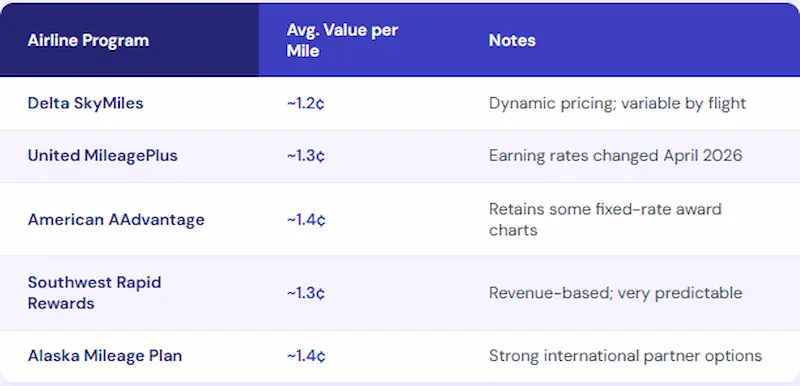
Airline miles have generally increased in value over the past few years as travel demand rebounded. However, dynamic pricing at Delta and United makes "sweet spot" redemptions harder to find. As a rule: long-haul premium cabin flights typically yield the highest value per mile (often 2¢+), while short domestic hops may give you only 0.8¢–1.0¢.
If you're holding airline miles, search award availability early — especially for international business or first class — to get the most out of each mile.
Hotel Points: High and Low Value Programs
Hotel points follow a different math than airline miles. Programs tend to give out large quantities of points, which inflates the currency and often results in lower per-point value. Here's how major hotel programs compare in 2026:
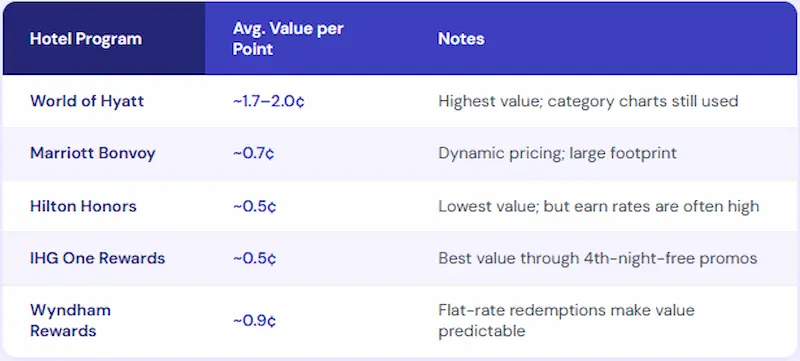
World of Hyatt is a standout: its points are worth more than four times the value of Hilton Honors points on average, which matters when deciding which hotel credit card to carry. A 3x Marriott card earning on dining is worth ~2.1¢ per dollar of value; a 3x Hyatt card on the same spend would be closer to 5.1¢ per dollar.
Pro tip: Always compare what a hotel stay costs in cash versus points before redeeming. If 50,000 hotel points saves you $250 cash (0.5¢ each), it may be smarter to pay cash and save the points for a higher-value luxury stay.
2026 Point Valuations at a Glance
Here's a full comparison table of major credit card rewards programs and their estimated per-point values in 2026:
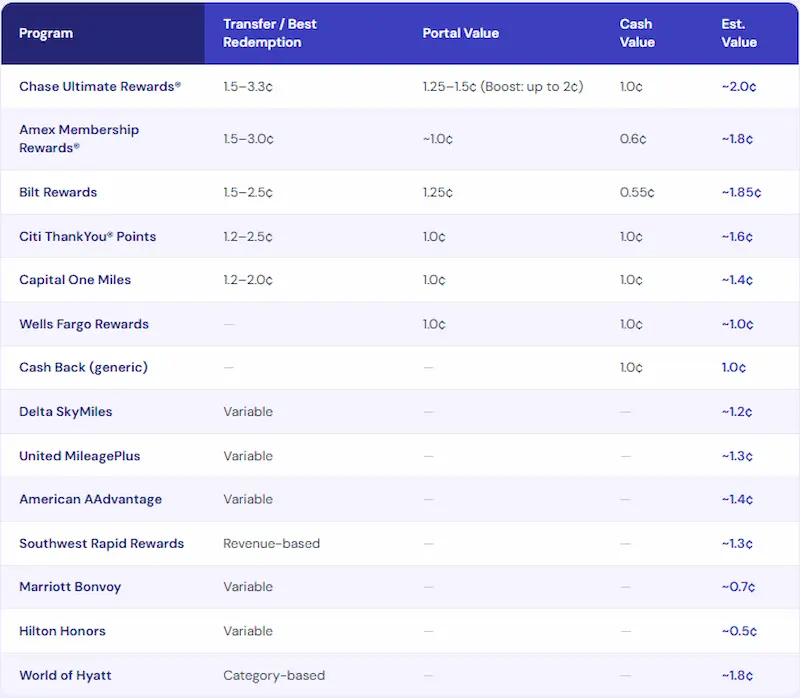
Values are estimates as of March 2026 and subject to change. Your actual value will vary based on specific redemptions.

Points vs. Miles: Is There Actually a Difference?
This is one of the most common questions in the rewards world: are "points" and "miles" the same thing? In practice, yes — almost entirely. Both are loyalty currencies you earn through spending; both can be redeemed for travel, cash back, or transfers; and both are subject to the same kind of devaluation over time.
The terminology difference is mostly branding. Airlines originally called their currencies "miles" to reflect actual flight distance. Credit card issuers adopted "points" as a more flexible term. Today, some airlines even use "points" (like Southwest Rapid Rewards "points") while some hotel cards earn "miles." Don't let the label influence your strategy — what matters is the redemption rate, not the name.
One practical difference: miles from airline-specific programs can only be redeemed within that airline's ecosystem (and partners), while flexible credit card "points" can often be transferred to multiple airlines and hotels, giving them more versatility and often higher overall value.
What Affects Point Value? Key Factors to Know
Several forces determine whether your points are worth closer to 0.5¢ or 2.0¢ on any given redemption:
Program devaluations happen when issuers, airlines, or hotels raise the points cost of a redemption. If a flight that cost 25,000 miles last year now costs 30,000 miles, your miles lost ~17% of their value overnight — without any announcement. This is the most common threat to accumulated balances.
Dynamic pricing has spread to more programs (Delta, United, Marriott, Hilton). When cash prices rise — during peak travel seasons, for example — award prices often rise in tandem, meaning inflation in the economy flows directly into your points balance.
Restrictions and availability matter because limited award seats or blackout dates can make "high-value" redemptions nearly impossible to access in practice. A mile is only worth what you can actually redeem it for.
Flexibility gives some programs a built-in floor and ceiling. Chase Ultimate Rewards, for example, always have a cash floor of 1¢ but can hit 2¢+ with the right transfer. Less flexible programs (a retailer's store card, for instance) have a narrow ceiling and often no transfer option.
Your personal situation is the final variable. If you rarely travel, even 2¢-per-point airline redemptions may not be accessible to you — in which case a flat 1.5% cash back card might actually deliver more usable value.
How to Calculate and Maximize Your Point Value

The formula every rewards cardholder should know:
Point Value (in cents) = (Cash Price ÷ Points Required) × 100
Example 1 — Hotel night: A hotel costs $200 or 30,000 points. → ($200 ÷ 30,000) × 100 = 0.67¢ per point. Probably not a great use.
Example 2 — Flight: A flight costs $350 or 25,000 miles. → ($350 ÷ 25,000) × 100 = 1.4¢ per mile. Decent value.
Example 3 — Business class transfer: A business class seat costs $2,000 or 60,000 transferred Chase points. → ($2,000 ÷ 60,000) × 100 = 3.33¢ per point. Excellent — this is the "sweet spot" savvy travelers chase.
To maximize your point value, follow these principles:
- Avoid merchandise and most gift card redemptions. These almost always deliver below 1¢ per point — the worst possible use of transferable points.
- Use travel portals as a floor, not a ceiling. The Chase or Amex travel portals deliver solid value (1.25–1.5¢), but transfer partners often beat them.
- Redeem for high-cost travel. The more a cash ticket would cost, the more value your points can unlock.
- Don't hoard forever. Points don't earn interest and often lose value over time through devaluations. Redeem when you have a use case — don't wait indefinitely.
- Stack rewards with tools like Kudos. By always using your best card at checkout, you maximize earning on every dollar spent — which means more points available for high-value redemptions.
Using Kudos to Track and Maximize Your Points
Managing multiple rewards currencies across several cards can get complicated fast. This is exactly where Kudos earns its keep.
Kudos shows all your reward balances across cards in one place, so you always know what you have available. Seeing 20,000 Chase points and 30,000 Delta miles in one dashboard — rather than logging into two separate portals — makes it much easier to plan a redemption strategically. You might realize you're 5,000 miles short of a Delta award and decide to put upcoming spending on your Delta card to bridge the gap.
Beyond tracking, Kudos's browser extension recommends the best card to use at each merchant in real time — ensuring you're earning the maximum points per dollar on every purchase, whether it's 3x on dining, 5x on travel, or a boosted Kudos Boost rate on top of your card's base earning.
Most importantly, Kudos helps prevent the silent value killer: forgotten points. Points left idle can expire, get devalued, or simply go unspent — essentially becoming worth zero. Awareness is step one in using them wisely.
Use code GET20 when signing up for Kudos to earn an extra $20 on your first eligible purchase.
FAQs: Credit Card Reward Point Values (2026)
What does "1 cent per point" mean in practical terms?
It means each point is equivalent to $0.01 in value, so 10,000 points = $100. This is the standard baseline for most cash back and fixed-value programs, and also the minimum acceptable rate for most travel card redemptions.
Are credit card points worth more than airline miles?
It depends on the program. Flexible credit card points (like Chase Ultimate Rewards or Amex Membership Rewards) are often more versatile and can deliver higher value than airline-specific miles because you can transfer them to multiple airlines and hotels. Airline miles may offer very high value on specific premium cabin redemptions, but that value is locked to one ecosystem.
Why are hotel points generally worth less than airline miles?
Hotel programs tend to issue large quantities of points (often 5x–10x per dollar on stays), which inflates the currency and keeps per-point value low. Airlines tend to issue fewer miles per dollar, keeping per-mile value higher. There are exceptions — World of Hyatt points (~1.8¢) rival many airline programs.
Can point values change without warning?
Yes — and they do, regularly. Issuers can raise the points cost of any redemption at any time, which effectively devalues your balance. Programs experiencing dynamic pricing (like Delta and Marriott) change their award costs continuously based on demand. This is one reason financial experts advise "earn and burn" rather than hoarding points indefinitely.
What is the worst way to redeem reward points?
Merchandise redemptions and statement credits through programs that penalize cash redemptions (like Amex at 0.6¢ per point for statement credits) are consistently the lowest-value uses. Gift cards at exactly 1¢ per point are acceptable but not optimal for flexible points programs that can deliver 1.5–2¢ through travel.
What credit score do I need to earn the best reward cards?
Premium travel rewards cards typically require good to excellent credit — generally a FICO score of 690 or higher, with stronger approval odds at 720+.
The content on this page is accurate as of the posting date; however, some of the offers mentioned may have expired. Rates and fees subject to change.
Unlock your extra benefits when you become a Kudos member



Turn your online shopping into even more rewards


Join over 400,000 members simplifying their finances



Editorial Disclosure: Opinions expressed here are those of Kudos alone, not those of any bank, credit card issuer, hotel, airline, or other entity. This content has not been reviewed, approved or otherwise endorsed by any of the entities included within the post.








.webp)

.webp)